| flashcard.png | ||
| pealim.apkg | ||
| pealim_dict.csv | ||
| pealim_dict_for_anki.csv | ||
| pealim_extract.py | ||
| README.md | ||


Pealim.com Dictionary To Anki Flash Cards
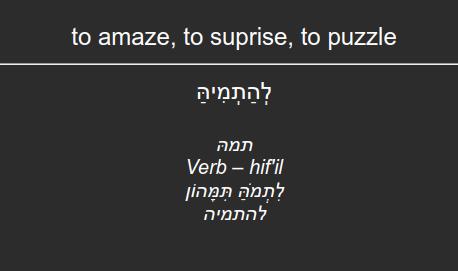
Tell me about the Script
This repository contains both the python script that can scrape the pealim.com website for dictionary words, as well as the resulting csv file 'pealim_dict.csv.' The script also has a function that adds tags by part of speech as well as add in a "shared roots" field that allows you to view the words with the same root. The resulting file is 'pealim_dict_for_anki.csv.' This file is then imported into Anki, where through a custom "pealim" note type, is turned into flash cards.
Just Give me the Flash Cards
The file that contains the formatted flashcards is 'pealim.akpg.' This is likely the file you want to import into Anki (you can import the csv files but then you have to manage your own custom note type).
Each word in the 'pealim.akpg' file has two cards: one that shows the word in hebrew and asks you for the english translation, and the other note does vice versa. Once the answer is provided, both notes show the root of the word, other words with the same root, part of speech, as well as the word written without nikkud (i.e. per the modern hebrew spelling).
The notes are also tagged with their parts of speech as well as their root to make it easy to search.
Suggested Usage
I would start by suspending all of the cards in the deck. As you read a text and encounter a word you don't know, use Anki's browsing capability to search for it or its root. Take a look at the other words with the same root to try and understand how the words are related. At this point you can:
A) Unsuspend just the new word that you have encountered or read
B) Unsuspend the new word, as well as all of the words with the same root
C) Employ a mixture of these strategies
Consider the fact that some roots are more productive than others, and some words with the same root are either not related at all or not easily related.
I would not recommend memorizing words that you are not reading or otherwise encountering-- it is much more difficult to remember words when you do not have the context for them. It is much easier when you are thinking of a word and you can remember the exact moment you saw it "in the wild," so-to-speak.
Lost in Translation
I would say the vast majority of the translations in the pealim.com dictionary are sufficient an helpful, however some of the definitions are not as good as they could be, or they do not provide enough context to truly understand what the word means. If you are suspicious of a definition, I suggest using the english-hebrew dictionary https://www.morfix.co.il/ as well as the hebrew dictionary https://milog.co.il.
Morfix has a much larger database that includes expressions and idioms that you might read or hear. Milog is the most in-epth however requires being able to understand the definitions in hebrew.
Fixing errors
Your options are to:
A) Fix your own deck based off of a superior definition you found
B) Inform pealim.com of a problem with one of their definitions, and then re-run the script to scrape their website (or ask me to re-run it and re-generate the files in this repository)